How Mascots Work—and Why They’re So Effective
A data-led analysis of 50 app mascots and 150 real placements: where brand characters appear, what jobs they do, and why the strongest ones stick.
Quick answer
The best app mascots work because they do more than look friendly. They make an abstract product tangible, give repeated product moments a consistent voice, turn progress into visible feedback, and build recognition through the same character appearing over time.
Our analysis of the 50 app mascots in the svgapp library found that brand identification and product metaphor is the most common primary job. But the more revealing pattern is where mascots go next: into onboarding, learning, progress, rewards, support, social content, and community culture.
50
researched mascot profiles
150
documented in-use examples
9
app and software categories
The practical conclusion is not “add a cute animal.” It is: give one distinctive character a useful, repeatable role and let familiarity compound.
How we analyzed the mascot library
This report uses a snapshot of the 50 public profiles in the svgapp Popular Brand Mascots database on August 14, 2026. Every profile contains a researched case study, source links, and three examples of the character in use, giving us 150 observed placements to compare.
We used two layers of analysis:
- Descriptive counts. We counted the library’s nine published product categories.
- Primary-role coding. We assigned each mascot one main job based on the role most central to its profile and product use. A character can perform several jobs; the single-label coding prevents the same case from inflating every category.
We then compared the observed patterns with research on picture memory, distinctive brand assets, anthropomorphism, human-computer interaction, and gamification.
What this analysis can—and cannot—prove
This is a cross-case analysis of a curated library, not a statistical meta-analysis of controlled mascot experiments. The sample intentionally favors recognizable and instructive app mascots, so its percentages describe this collection, not every app in the market. They show where successful teams deploy characters and reveal useful hypotheses; they do not prove that a mascot caused any company’s growth.
That distinction matters. App-store ratings, social reach, or company performance can establish scale, but they cannot isolate the mascot’s contribution. Where we discuss psychological mechanisms, we cite the relevant research and avoid turning a related finding into a made-up conversion promise.
Where app mascots are most common
The 50 examples span nine categories. Developer tools are the largest single group, but no category accounts for more than 16% of the sample.
| Product category | Mascots | Share of sample |
|---|---|---|
| Developer Tools | 8 | 16% |
| Work & Productivity | 7 | 14% |
| Social & Community | 7 | 14% |
| Health & Wellness | 7 | 14% |
| Education & Learning | 6 | 12% |
| Platforms & Utilities | 5 | 10% |
| Travel & Mobility | 5 | 10% |
| AI & Companions | 4 | 8% |
| Finance | 1 | 2% |
One pattern deserves attention: 24 of 50 mascots (48%) come from developer tools, productivity, platforms, or AI products. These products often sell something invisible—a runtime, workflow, platform, model, or automated service. A character gives that abstraction a stable visual proxy.
Docker’s whale carries containers. GitHub’s Mona gives a code-hosting platform a community-friendly face. DigitalOcean’s Sammy makes a technical learning ecosystem feel more approachable. Microsoft Copilot’s Mico gives an otherwise invisible conversational system a visible presence.
The distribution also shows that mascots are not limited to children’s products. Developer tools alone outnumber education in this sample. The common factor is not a young audience; it is a need to make an abstract system easier to recognize, explain, or relate to.
The six jobs mascots are hired to do
We coded one primary role for each of the 50 cases. Brand identification and product metaphor is the largest group, while the remaining cases spread across guidance, behavior, companionship, content, and community.
| Primary mascot job | Mascots | Share | Representative examples |
|---|---|---|---|
| Brand identifier or product metaphor | 18 | 36% | Docker, Bun, Hopper, Mailchimp |
| Guide, teacher, or explainer | 8 | 16% | DigitalOcean, Mimo, Salesforce, Wysa |
| Habit, progress, or reward | 6 | 12% | Duolingo, Finch, Asana, Waterllama |
| Companion or care object | 6 | 12% | Mico, Lumo, Tolan, Widgetable |
| Social or content performer | 6 | 12% | Dax, Kit, Mussy, Taco |
| Community or world-builder | 6 | 12% | Mona, Snoo, Wapuu, Wumpus |
Do not over-read the four-way tie at 12%; the primary-role coding deliberately compresses characters with several functions. The important result is the spread. Nearly two thirds of the sample has a main job beyond identification. Strong mascot systems become product and communication infrastructure, not a logo with extra limbs.
The full coding behind those totals is:
- Brand identifier or product metaphor (18): Android Bot, Boo’s ghost, Bun, CodeRabbit, Bits, Deno, Moby Dock, Finder, Owly, Hopper’s bunny, Bellboy, LingoDeer, Freddie, Roger Mozbot, Popabear, Ollie, Weegio, and Yettie.
- Guide, teacher, or explainer (8): Sammy, Kodi Bear and friends, the Feelings Monster, Mimo’s robot, Astro, Snoop’s robot, Splashee, and Wysa’s penguin.
- Habit, progress, or reward (6): the Celebration Creatures, Duo, Finch’s birb, Bean, Voidpet’s creatures, and Waterllama.
- Companion or care object (6): Pengu, Bao and Mellow, Livie, Mico, Lumo, Tolan, and Widgetable’s pets.
- Social or content performer (6): Dax, Kit, Mussy, the PostHog hedgehog, Toast, and Taco.
- Community or world-builder (6): Wumpus, Mona, Molty, Pudgy Penguin, Snoo, and Wapuu.
1. Brand identifier or product metaphor
This is the entry-level job: make the name, category, or product promise easier to picture. Bun turns a short runtime name into a smiling character. Hopper uses a rabbit whose movement reinforces the brand name. Docker’s whale carrying containers compresses a technical abstraction into one image.
The best metaphors do two jobs at once. They identify the company and help a newcomer remember what kind of thing it does. The weakest simply repeat the name without adding meaning.
2. Guide, teacher, or explainer
Guides are common where users face unfamiliar concepts or sensitive tasks. Sammy appears around developer education. Mimo’s robot supports beginner coding. Salesforce’s Astro guides people through the Trailhead learning world. Wysa’s penguin helps frame difficult conversations without pretending the interface is a human clinician.
The mascot works here when it reduces uncertainty. It should point toward the next action, model a concept, or make instructional content feel continuous. It fails when the character adds dialogue but no clarity.
3. Habit, progress, or reward
This group places the character inside the behavior loop. Duo embodies the request to return and practice. Finch’s birb grows through self-care activity. Focus Friend’s Bean knits while the user focuses. Asana’s Celebration Creatures appear after completed work.
These mascots make an invisible state—effort, time, continuity, completion—visible. The character is most effective when it follows real progress. If celebration arrives before a task is saved, or guilt replaces useful feedback, the same mechanism becomes manipulative.
4. Companion or care object
Companions make an ongoing relationship part of the product. Tolan, Mico, Lumo, and Widgetable’s pets are not just narrators standing beside the interface. Their presence, state, or customization is part of what users return to.
This role needs especially clear boundaries. A character can make software feel less sterile, but it should not misrepresent a system’s abilities, emotions, privacy, or professional authority.
5. Social or content performer
A logo cannot look surprised by a news event, enter a running joke, or star in a recurring story. A character can. DuckDuckGo’s Dax, Firefox’s Kit, Musa’s Mussy, and Trello’s Taco turn one visual identity into a repeatable content format.
The production advantage is easy to miss. Once the character has a stable personality and pose system, every new post begins with a known protagonist rather than a blank artboard.
6. Community or world-builder
Mona the Octocat, Reddit’s Snoo, WordPress’s Wapuu, and Discord’s Wumpus gain meaning through variation. Event versions, local adaptations, stickers, costumes, and community art let the audience participate while the base character remains recognizable.
This is the point at which a mascot can become shared culture. It also requires governance: define which features must stay fixed, which may change, and who may create official-looking derivatives.
Where mascots appear in the customer journey
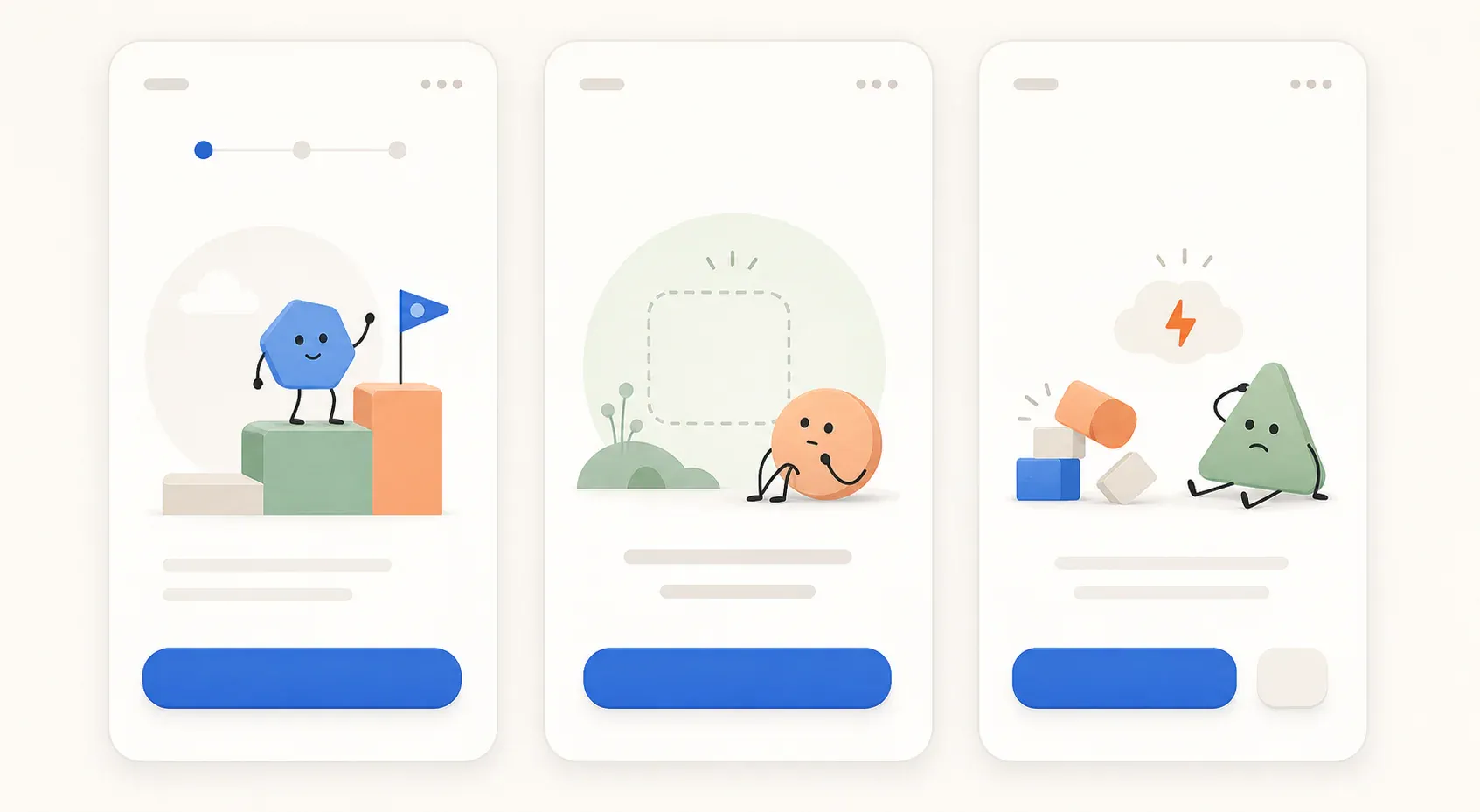
The 150 use-case examples show that mascot placement is better understood as a journey than as a list of screens. A useful character can move from first recognition to product feedback and then into community culture.
| Journey layer | Common placements | What the mascot contributes | Examples |
|---|---|---|---|
| Recognition | App icon, wordmark, store listing, homepage | Fast attribution and a concrete brand cue | Bun, Deno, Hopper, Boo |
| First use and learning | Welcome, onboarding, tutorials, docs | Orientation and a consistent teaching voice | Mimo, Sammy, Astro |
| Core behavior | Reminders, progress, focus, completion | Visible feedback and emotional continuity | Duo, Finch, Bean, Asana |
| Recovery and support | Empty states, errors, privacy, help | Tone and reassurance around friction | Wysa, Wumpus, PostHog |
| Lifecycle marketing | Email, launches, changelogs, social posts | A repeatable protagonist for new stories | Dax, Kit, Mussy, Taco |
| Community and physical media | Events, stickers, plush, costumes, merchandise | Participation, belonging, and offline recognition | Mona, Snoo, Wapuu, Duo |
The highest-leverage systems cross several layers without using the same emotional intensity everywhere. Duo can be theatrical on social media and still needs to be clear inside a lesson. A support mascot should be calmer than a launch mascot. Consistency means the same character logic, not the same pose and tone in every context.
Why mascots can be so effective
The research supports five mechanisms. None is a guarantee; each explains why a well-designed, well-placed character can outperform decoration.
1. A character creates a stronger memory cue
Classic experimental work on the picture-superiority effect found better recognition for pictures than for their verbal labels. That result concerns picture memory generally, not mascots specifically, but it helps explain why a concrete character can be easier to retrieve than another abstract product claim.
Brand distinctiveness adds a harder commercial test: can people connect the cue to the correct company? In Ipsos and JKR’s research with more than 26,000 respondents, only 16% of tested mascots reached its “gold” distinctiveness standard. Logos scored 19%, slogans 6%, and colors 4% in the same study. The lesson is not that mascots are magic. It is that a mascot only becomes an asset when its form is distinctive and its use is consistent enough to build the right association.
In other words, “cute” is not a memory strategy. A recognizable silhouette, stable color logic, and repeated pairing with the same brand are.
2. Anthropomorphism gives the product readable intent
Psychologists Nicholas Epley, Adam Waytz, and John Cacioppo describe anthropomorphism as attributing humanlike characteristics, motivations, intentions, or emotions to nonhuman agents. Their three-factor theory explains why people do this more readily in some situations than others.
A mascot supplies cues that make this process easy: eyes suggest attention, posture suggests confidence or concern, and expression makes a product state emotionally legible. The character lets a system appear to welcome, think, celebrate, or apologize without presenting an actual employee.
Research by Clifford Nass and Youngme Moon found that people can apply learned social rules such as politeness and reciprocity to computers, even when they do not consciously believe the machine is a person. Their review of experimental studies helps explain why small social cues in an interface can change how an interaction feels.
That does not mean a face makes software trustworthy. It means people read social meaning into interface cues, so those cues need to be designed responsibly.
3. Mascots translate abstract states into visible feedback
A progress percentage is precise but emotionally thin. A bird growing, a bean knitting, or a narwhal crossing the screen turns state change into an event. The character gives users a before-and-after they can see.
This overlaps with gamification, where the evidence is conditional. A review of empirical gamification studies found mostly positive effects but emphasized that results depend on users and context. A controlled study of specific game elements likewise found that different elements support different psychological needs rather than producing one universal motivation boost.
The mascot therefore should not be credited with “engagement” in the abstract. Test the concrete mechanism: Does the celebration clarify completion? Does the companion make progress easier to understand? Does the reminder improve return without creating pressure?
4. One character can carry many messages without resetting the brand
Recurring characters accumulate context. Users who already know the mascot do not need every campaign, notification, or release graphic to reintroduce the brand voice from zero.
Advertising researchers call a recurring character or scenario a fluent device. System1’s analysis of long-running campaigns in the IPA Effectiveness Databank found an association between fluent devices and long-term business effects. That is observational advertising evidence, not an app-interface experiment, but it matches what the library shows: Dax, Duo, Snoo, Mona, and Wapuu can enter new situations while carrying old recognition with them.
This is why a pose library matters. It turns brand consistency from a static rule into a production system.
5. A mascot can add warmth without depending on a human spokesperson
Software often communicates in moments that are emotionally uneven: first-run uncertainty, an empty dashboard, a failed action, a completed goal. A character gives designers more emotional range than a logo and more control than a celebrity or founder-led identity.
Consumer research does show that people can perceive brands as humanlike, self-relevant, or relationship-like. But a major review of brand humanization research also makes clear that these are distinct processes with different conditions. The careful claim is that mascots provide capacity for warmth and relationship cues. Whether users welcome those cues depends on the design, context, and behavior of the brand.
What separates an effective mascot from a merely cute one
Across the 50 cases, six design principles recur.
| Principle | What it looks like in practice | The test |
|---|---|---|
| Product fit | Species, form, or behavior connects to the name or job | Can someone explain why this character belongs to this product? |
| Distinctive structure | Ownable silhouette, proportions, face, and color anchors | Is it recognizable without the wordmark? |
| A defined job | The mascot guides, rewards, explains, performs, or gathers community | What useful moment disappears if the mascot is removed? |
| Emotional range | Poses cover welcome, thought, success, concern, and recovery | Can it respond without becoming a different character? |
| System consistency | Reusable rules govern pose, palette, motion, and voice | Can another teammate make the next asset on-model? |
| Restraint | Frequency and intensity match the user’s task | Does the character help without blocking, guilting, or distracting? |
Product fit is the foundation. Docker’s whale is memorable partly because the load of containers relates to the product metaphor. Finch’s bird matters because care for the character is connected to the app’s self-care loop. Asana’s creatures work because they arrive after completion and then leave.
Distinctiveness and repetition do the long-term work. The design needs a small set of stable anchors—silhouette, face geometry, dominant colors, and behavioral rules—while poses, props, scenes, and expressions change around them.
When mascots backfire
Anthropomorphism creates expectations as well as affection. A character that appears intentional can also appear responsible, intrusive, competitive, or manipulative.
Research in the Journal of Consumer Research found that anthropomorphized brands can be evaluated less favorably when they threaten a consumer’s sense of agency or distinctiveness; a supporter framing performs differently from a controller framing. Separate Journal of Marketing experiments found that humanizing a brand can worsen reactions after product wrongdoing.
For product teams, the risks are concrete:
- False reassurance: a cheerful character cannot substitute for an accurate error, privacy, health, or financial explanation.
- Guilt mechanics: disappointment can turn a habit companion into emotional pressure.
- Tone mismatch: whimsy around payment failure, sensitive health data, or serious work may feel dismissive.
- Overexposure: a celebration on every click becomes friction, not delight.
- Character drift: inconsistent faces, proportions, or voice weaken recognition and can make AI-generated assets look unofficial.
- Accessibility failures: motion, sound, and expressive color still need reduced-motion behavior, controls, contrast, and clear text.
The governing rule is simple: the product state must remain true and understandable without the mascot. The character can shape tone and attention; it should not carry critical meaning alone.
A practical mascot strategy based on the data
Use this sequence before commissioning a large character library.
1. Write the mascot’s job in one sentence
“Our mascot celebrates saved work” is useful. “Our mascot makes us fun” is not specific enough to guide placement or measurement.
2. Choose one product-native metaphor
Connect the character to the product name, core action, audience, or promise. Avoid a random animal chosen only because it is cute.
3. Start with three real surfaces
Choose one recognition surface, one product moment, and one communication surface—for example: app icon, empty state, and launch post. Test the same design at all three sizes before expanding.
4. Build six core states
Start with neutral, welcome, thinking, success, concern, and recovery. Add poses only when a real product or content need appears.
5. Define behavior as carefully as appearance
Document what the mascot wants, how it speaks, how intense it may become, and which subjects require plain product language instead of character voice.
6. Measure the job, not “mascot engagement”
Use a controlled comparison where possible. Match the metric to the placement:
- Recognition: correct brand attribution with the wordmark hidden
- Onboarding: next-step comprehension and completion
- Empty states: clicks into the intended first action
- Errors: successful recovery, not smiles or reactions
- Habit loops: return behavior alongside opt-outs and notification complaints
- Content: attributed reach, saves, and repeat recognition
- Production: pose reuse and time to create an on-brand asset
A mascot should earn wider distribution one surface at a time.
The real reason mascot systems compound
A logo identifies. A mascot can identify and act.
That extra verb is the source of the advantage. The character can guide a first session, reflect progress, acknowledge failure, teach a concept, react to culture, and appear at a community event while remaining one recognizable asset.
The 50 cases in this analysis do not prove a universal uplift. They show a repeatable strategic pattern: effective mascots combine memory, meaning, and utility. Remove any one of the three and the system weakens. Memory without meaning becomes a gimmick. Meaning without utility stays in the brand deck. Utility without consistency becomes another disposable illustration.
Build the character around a product truth, give it a narrow first job, and repeat the cues long enough to become recognizable. That is how a mascot stops being decoration and starts becoming an asset.
Research and data sources
- svgapp Popular Brand Mascots database — 50-profile dataset and 150 documented use-case examples analyzed for this report
- Nelson, Reed, and Walling: “Pictorial superiority effect” — experimental research on recognition for pictures and verbal labels
- Ipsos and JKR: “Be Distinctive. Everywhere.” — more than 26,000 respondents rating logos, slogans, mascots, colors, and products
- Epley, Waytz, and Cacioppo: “On Seeing Human” — a three-factor theory of anthropomorphism
- Nass and Moon: “Machines and Mindlessness” — review of experiments on social responses to computers
- MacInnis and Folkes: “Humanizing Brands” — review of research on humanlike, self-connected, and relationship-like brands
- Hamari, Koivisto, and Sarsa: “Does Gamification Work?” — literature review of empirical gamification studies
- Sailer et al.: “How Gamification Motivates” — experiment on game elements and psychological need satisfaction
- Puzakova and Aggarwal: “Brands as Rivals” — experiments on anthropomorphism, distinctiveness, and agency
- Puzakova, Kwak, and Rocereto: “When Humanizing Brands Goes Wrong” — experiments on brand anthropomorphism after product wrongdoing
- System1: research on recurring character “fluent devices” — observational analysis of long-running advertising campaigns
Build a mascot with a real product job
Create a consistent character system for onboarding, progress, support, launches, and the moments your users actually see.
Create Your Mascot